

The Complete Guide to Hiring in Germany (2026): Employment Law, Payroll, and Compliance

Germany is one of the most powerful economies in the world and one of the most attractive destinations for international businesses looking to hire top talent in Europe. With the fourth largest GDP globally, a workforce of over 45 million skilled professionals, and deep expertise across technology, engineering, manufacturing, and finance, hiring in Germany in 2026 offers significant opportunities for businesses ready to expand.
But Germany is also one of the most regulated labor markets in the world. Its employment laws are detailed, its employee protections are among the strongest anywhere, and the consequences of non-compliance — whether through incorrect contracts, payroll errors, or worker misclassification — can be severe and costly.
This guide covers everything international businesses need to know about hiring in Germany in 2026, including employment law, payroll and tax obligations, employee benefits, compliance risks, and how modern platforms like Deel make the entire process faster, simpler, and fully compliant.
Why Hire in Germany in 2026?
Germany’s labor market remains one of the strongest and most resilient in Europe. The country’s workforce is highly educated, technically skilled, and productive across virtually every major industry. For businesses expanding into Europe, Germany offers a central geographic location, world-class digital and transport infrastructure, and access to the European Union’s single market.
The demand for skilled professionals in Germany — particularly in software development, data science, engineering, and healthcare — continues to outpace domestic supply in many sectors. International businesses that move quickly to establish a compliant hiring presence in Germany can gain a genuine competitive advantage in attracting high-quality candidates.
However, Germany’s employment landscape is not one that rewards shortcuts. The country’s legal framework is built around protecting workers, and businesses that fail to respect that framework face real financial and legal consequences. Understanding German employment law before you hire is not optional — it is essential.
German Employment Law: The Foundation
German employment law is built on a series of key pieces of legislation that work together to create one of the most employee-protective legal frameworks in the world.
The Civil Code (Bürgerliches Gesetzbuch) provides the foundational framework for employment contracts and the obligations of both parties. The Dismissal Protection Act (Kündigungsschutzgesetz) protects employees from unfair termination in companies with more than ten employees. The Working Hours Act (Arbeitszeitgesetz) sets strict limits on daily and weekly working time. The Federal Leave Act (Bundesurlaubsgesetz) establishes minimum paid annual leave entitlements. The Part-Time and Fixed-Term Employment Act (Teilzeit- und Befristungsgesetz) regulates fixed-term contracts and part-time arrangements. And the Works Constitution Act (Betriebsverfassungsgesetz) governs the rights of works councils — employee representative bodies that hold significant power in German workplaces.
Compliance with this body of law is non-negotiable for any business operating in Germany. The German authorities and labor courts are well-resourced and active in enforcing employment standards.
Types of Employment Contracts in Germany
Choosing the right type of employment contract is one of the first and most important decisions when hiring in Germany. Using the wrong contract type — or a contract that fails to include legally required terms — can expose a business to significant legal risk from day one.
Permanent Employment Contracts
The permanent employment contract (unbefristeter Arbeitsvertrag) is the most common form of employment agreement in Germany. It has no fixed end date and, after the probationary period, entitles the employee to the full protections of the Dismissal Protection Act, including protection against unfair termination.
Every permanent contract must be provided to the employee in writing before their start date. It must include the job title and description, the gross salary, working hours, notice periods, annual leave entitlement, and any other key terms agreed between the parties. A poorly drafted contract — or one that omits legally required information — creates uncertainty and potential liability.
Fixed-Term Contracts
Fixed-term contracts (befristeter Arbeitsvertrag) are permitted in Germany but are tightly regulated under the Part-Time and Fixed-Term Employment Act. A fixed-term contract without a specific legal justification can last a maximum of two years. Within that two-year window, the contract may be renewed up to three times. Once the two-year limit is reached, the contract automatically converts to a permanent one by operation of law.
Fixed-term contracts with a valid legal justification — such as covering for an employee on maternity or parental leave, or completing a clearly defined project — can in some circumstances exceed two years. However, the justification must be genuine, documented, and legally sound.
Probationary Period
German law allows an initial probationary period of up to six months at the beginning of an employment relationship. During this period, either party may terminate the contract with just two weeks notice, without the need to provide detailed justification. Once the probationary period ends, the standard statutory notice periods and full dismissal protections apply.
Independent Contractors
Engaging workers as independent contractors rather than employees is legally possible in Germany, but it carries serious risk. German authorities actively investigate what they call Scheinselbständigkeit — false self-employment or worker misclassification. If a worker who should be classified as an employee is instead engaged as a contractor, the consequences for the business can be devastating.
Working Hours and Overtime in Germany
The German Working Hours Act places strict and enforceable limits on the number of hours employees can be required to work. The standard maximum is eight hours per day. This can be extended to ten hours per day, but only if the average over a rolling six-month period does not exceed eight hours per day. The absolute maximum working week is 48 hours.
Employees are entitled to a minimum of eleven consecutive hours of rest between shifts. Those working more than six hours in a day are entitled to a thirty-minute rest break. Those working more than nine hours are entitled to a forty-five-minute break.
Overtime arrangements in Germany vary depending on the employment contract and any applicable collective bargaining agreement. German courts have consistently held that employment contracts which purport to absorb all overtime without compensation are unenforceable. Businesses must ensure that overtime arrangements are clearly documented and fairly compensated.
Minimum Wage in Germany in 2026
Germany introduced a statutory national minimum wage in 2015, and it has increased steadily since then. The minimum wage applies to all employees in Germany regardless of their nationality, industry, contract type, or the size of the company they work for.
As of 2024, the minimum wage stood at €12.41 per hour gross. The Minimum Wage Commission reviews the rate regularly, and further increases are expected in 2026. Businesses hiring in Germany should verify the current applicable minimum wage rate at the time of hiring. Paying below the minimum wage is a serious legal violation and can result in fines of up to €500,000 per case.
Payroll in Germany: Taxes and Social Security
Running payroll in Germany is one of the most administratively complex aspects of employing German workers. Employers are legally responsible for calculating, withholding, and remitting a range of taxes and social security contributions on behalf of each employee, every single month.
Income Tax
Germany operates a progressive income tax system. Tax rates range from zero percent for low earners to forty-five percent for the highest earners. Employers must withhold the correct amount of income tax from each employee’s gross salary every month and remit it to the relevant local tax office. The correct amount depends on the employee’s assigned tax class, which is determined by their personal circumstances including marital status and number of dependent children.
Solidarity Surcharge
The solidarity surcharge was abolished for the majority of taxpayers in 2021. However, it continues to apply to higher earners whose annual income tax liability exceeds the statutory threshold. Employers must check whether any employees are subject to the surcharge and withhold it alongside income tax where applicable.
Church Tax
Employees who are registered members of a recognized religious community in Germany — primarily Roman Catholic or Protestant — are subject to church tax at a rate of eight or nine percent of their income tax liability, depending on the federal state in which they are registered. Employers are responsible for withholding and remitting church tax for affected employees.
Social Security Contributions
Germany’s social security system is funded through contributions shared between employers and employees. The four pillars of the system are health insurance, pension insurance, unemployment insurance, and long-term care insurance.
Health insurance contributions amount to approximately 14.6 percent of gross salary plus an additional supplementary contribution that varies by the employee’s chosen health insurance provider, split broadly equally between employer and employee. Pension insurance stands at 18.6 percent of gross salary, split equally. Unemployment insurance is 2.6 percent, split equally. Long-term care insurance is approximately 3.4 percent, with the exact split depending on whether the employee has children.
In total, employers should budget for approximately 20 to 21 percent of an employee’s gross salary in additional social security contributions on top of the salary itself. For a business hiring multiple employees, this represents a very significant additional cost that must be accounted for in financial planning.
Payroll Reporting Obligations
German employers must submit monthly payroll tax declarations to the relevant tax office and monthly social security contribution reports to the relevant social security institutions. They must provide employees with a detailed payslip every month and issue annual income tax certificates at the end of each calendar year. Late or inaccurate submissions attract penalties and interest charges.
Employee Benefits and Leave Entitlements in Germany
German law provides employees with a comprehensive and legally mandated set of benefits and entitlements. Employers have no discretion over whether to provide these — they are legal obligations that apply from the first day of employment.
Annual Leave
The Federal Leave Act entitles all employees working a standard five-day week to a minimum of twenty days of paid annual leave per year. In practice, most collective agreements and individual employment contracts in Germany provide between twenty-five and thirty days of annual leave. Offering only the statutory minimum may make it harder to attract and retain competitive candidates in Germany’s tight labor market.
Public Holidays
Germany has between nine and thirteen public holidays per year, with the exact number varying by federal state. Bavaria has the highest number of public holidays of any German state, while states such as Berlin and Hamburg have fewer. All employees are entitled to paid time off on applicable public holidays.
Sick Leave
German employees are entitled to six weeks of continued full salary payment if they are unable to work due to illness. This obligation falls entirely on the employer for the first six weeks. After six weeks, the employee’s statutory health insurance fund takes over and pays sick pay at approximately seventy percent of the employee’s gross salary, for a total of up to seventy-eight weeks.
Employees must notify their employer of their inability to work on the first day of absence. From the fourth day of illness onwards, a doctor’s certificate is required.
Parental Leave
Germany offers some of the most generous parental leave provisions in the world. Both parents are entitled to take up to three years of parental leave per child, usable at any point up until the child’s eighth birthday. Employees on parental leave are protected from dismissal. The government pays parental allowance for up to fourteen months at sixty-five to sixty-seven percent of the parent’s previous net income, subject to a maximum of €1,800 per month.
Maternity Protection
Pregnant employees in Germany are protected by the Maternity Protection Act from the moment they inform their employer of their pregnancy. A mandatory protection period of six weeks before the expected birth date and eight weeks after the birth applies, during which the employee cannot be required to work. Full salary continues to be paid throughout this period. Employees cannot be dismissed from the start of pregnancy until four months after giving birth.
Compliance Risks When Hiring in Germany
Germany’s regulatory environment creates a number of significant compliance risks for international businesses. These risks are real, the consequences of getting them wrong are serious, and understanding them before you hire is far cheaper than dealing with them after the fact.
Worker Misclassification
Misclassifying an employee as an independent contractor — Scheinselbständigkeit in German — is one of the most serious and costly compliance mistakes a business can make when hiring in Germany. If the German social security authorities or tax office determine that a worker has been misclassified, the business faces back payment of all employer and employee social security contributions for the entire duration of the misclassified engagement, income tax back payments, fines of up to €30,000 per individual violation, and in serious cases criminal prosecution.
German authorities assess worker classification on the basis of multiple factors: the degree to which the worker is integrated into the company’s operations, whether the worker works exclusively for one client, the degree of control the company exercises over how and when the work is performed, and whether the worker bears genuine entrepreneurial risk. A worker who looks like a contractor on paper but operates like an employee in practice will almost certainly be reclassified.
Works Councils
In any German company with five or more permanent employees, the workforce has the right to elect a works council (Betriebsrat). Works councils in Germany hold extensive co-determination rights that cannot legally be bypassed or ignored.
Works councils must be consulted before any new employee is hired. They must be involved in decisions about changes to working conditions, working hours, or workplace monitoring systems. They have the right to be informed and consulted before any redundancies are made. Ignoring a works council — or failing to involve it in decisions that fall within its remit — can result in those decisions being declared legally invalid by a German labor court.
Dismissal Protection
Once the probationary period ends, employees in companies with more than ten employees are protected against unfair dismissal under the Dismissal Protection Act. Terminating an employee in Germany is only legally permissible for one of three valid reasons: personal reasons such as a permanent inability to perform the required duties, behavioural reasons such as a serious breach of employment obligations, and operational reasons such as a genuine and documented redundancy.
If a German labor court finds that a dismissal was not legally justified, it can order the reinstatement of the dismissed employee or require the employer to pay significant compensation. Managing dismissals without proper legal guidance in Germany is one of the highest-risk activities a business can engage in.
GDPR and Data Protection
Germany is one of the strictest enforcers of GDPR compliance in Europe. German data protection authorities are among the most active in the European Union, and fines for serious violations can be substantial. Employers processing employee personal data must have a lawful basis for each category of data they process, must inform employees transparently about how their data is used, and must implement robust technical and organizational security measures.
Setting Up a Legal Entity vs Using an Employer of Record in Germany
When expanding into Germany, one of the most strategically important decisions a business faces is whether to establish a local legal entity or use an Employer of Record service.
Setting up a GmbH — Germany’s most common form of limited liability company — requires a minimum share capital of €25,000 and typically takes between four and eight weeks to complete even under favorable conditions. Once established, a GmbH comes with ongoing annual compliance obligations including the preparation and filing of financial statements, corporate tax returns, and trade tax returns. This approach makes sense for businesses with long-term plans to build a significant commercial presence in Germany.
For businesses that want to hire in Germany quickly, test the market before committing to entity setup costs, or maintain a lean German team without the overhead of entity compliance, an Employer of Record service offers a far more practical and cost-effective solution. With an EOR, a business can have a fully compliant German employment contract in place and a new employee onboarded within days rather than months.
How Deel Simplifies Hiring in Germany
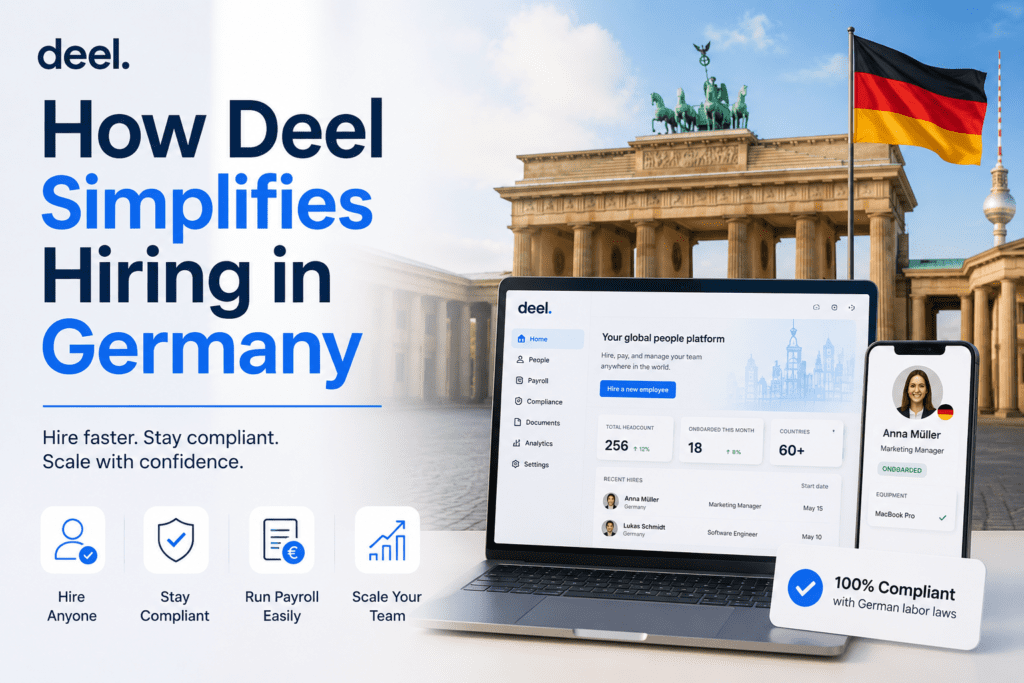
Deel is a global workforce management platform trusted by over 35,000 companies around the world, from early-stage startups to large multinationals. Deel operates its own legal entity in Germany and employs an in-house team of German employment law and payroll experts, making it one of the most reliable and fully compliant ways to hire in Germany without establishing a local entity.
Deel generates employment contracts that are fully compliant with German labor law — written in German, incorporating all legally required terms, and tailored to the specific role, employment type, and applicable collective agreements. This eliminates the risk of using a generic contract template that fails to meet Germany’s exacting legal requirements.
Deel handles every aspect of German payroll, including income tax withholding across all tax classes, employer and employee social security contributions across all four pillars of the system, church tax withholding where applicable, and all required monthly and annual reporting submissions. Everything is calculated accurately and submitted on time, removing the risk of payroll errors, late filings, and the penalties that accompany them.
Deel ensures that all statutory employee benefits — annual leave entitlement, sick pay obligations, parental leave protections, maternity protection, and pension contributions — are correctly calculated, managed, and provided. Optional supplementary benefits packages can also be configured through the Deel platform to help attract and retain top talent in Germany’s competitive labor market.
For companies without a German legal entity, Deel’s Employer of Record service means that Deel becomes the legal employer of the German employees on paper, assuming all employment law obligations, while the employees work exclusively for the client’s business. This allows companies to hire in Germany with complete legal compliance and without the cost, complexity, or timeline of GmbH formation.
Deel also provides expert worker classification support, helping businesses correctly distinguish between employees and independent contractors and dramatically reducing the risk of the Scheinselbständigkeit findings that have proved so costly for many international companies operating in Germany.
Throughout the engagement, Deel’s in-country German legal and compliance team monitors changes in employment law, minimum wage rates, social security contribution rates, and tax regulations on an ongoing basis, ensuring that client companies always remain compliant without having to maintain their own internal German legal expertise.
The True Cost of Hiring in Germany
Understanding the total cost of employment in Germany is essential for accurate budgeting and financial planning. For an employee earning €60,000 per year in gross salary, the approximate total annual employer cost breaks down as follows.
The gross salary itself is €60,000. Employer health insurance contributions add approximately €4,500. Employer pension insurance contributions add approximately €5,580. Employer unemployment insurance contributions add approximately €780. Employer long-term care insurance contributions add approximately €1,020. This brings the total direct employer cost to approximately €71,880 per year — representing an additional cost of approximately 19.8 percent above the gross salary.
These figures are approximate and will vary depending on the specific health insurance provider chosen by the employee, any applicable collective bargaining agreements, and the employee’s individual tax circumstances. They also exclude indirect costs such as recruitment fees, onboarding expenses, equipment, office space if applicable, and the administrative burden of managing payroll and compliance internally.
When all costs are factored in, many businesses find that using Deel — which consolidates compliant contracts, accurate payroll processing, statutory benefits management, and access to in-country legal expertise into a single transparent monthly fee — is more cost-effective than attempting to build and manage the same capabilities in-house.
Frequently Asked Questions About Hiring in Germany
Do I need a German legal entity to hire employees in Germany?
No. Using an Employer of Record service like Deel allows you to hire employees in Germany without establishing a local entity. Deel acts as the legal employer and assumes all compliance obligations, while your employees work exclusively for your business.
How quickly can I hire someone in Germany using Deel?
With Deel, you can have a fully compliant employment contract in place and your new German employee onboarded within a matter of days. This compares favorably with the four to eight weeks — or longer — typically required to set up a GmbH.
What are the notice periods for terminating an employee in Germany?
During the probationary period, either party may terminate with two weeks notice. After the probationary period, the minimum statutory notice period is four weeks to the fifteenth or end of a calendar month. The required notice period increases with length of service, up to a maximum of seven months for employees with twenty or more years of service.
Are collective bargaining agreements relevant to my business?
They may be. Germany has a strong tradition of sectoral collective bargaining, and many industries are covered by collective agreements that set minimum standards for pay, working hours, and benefits above the statutory floor. Whether a collective agreement applies to your business depends on your industry, your legal form, and whether you are a member of the relevant employers’ association.
Can I hire a remote worker based in Germany without a German entity?
Yes. Deel’s Employer of Record service is specifically designed for this scenario. You can hire a remote professional based anywhere in Germany, with Deel handling all employment law, payroll, and compliance obligations.
Conclusion
Hiring in Germany in 2026 offers access to world-class talent and one of Europe’s most stable and prosperous economies. But the country’s complex employment laws, strict compliance requirements, high employer costs, and strong traditions of worker protection mean that businesses must approach the German labor market with care, preparation, and the right tools in place.
The businesses that succeed in Germany are the ones that take compliance seriously from the very start — not as a box-ticking exercise, but as a genuine foundation for building productive, sustainable employment relationships with their German workforce.
Deel provides the legal infrastructure, local expertise, and streamlined processes that international businesses need to hire in Germany with complete confidence — without the need to establish a local entity, navigate Germany’s complex payroll system alone, or worry about staying on top of an ever-evolving body of employment law.
Ready to hire your first employee in Germany the right way?
This guide is provided for informational purposes only and does not constitute legal or tax advice. Employment law, tax regulations, and social security contribution rates in Germany are subject to change. For advice specific to your situation, we recommend consulting a qualified employment lawyer or using a compliant platform such as Deel.