

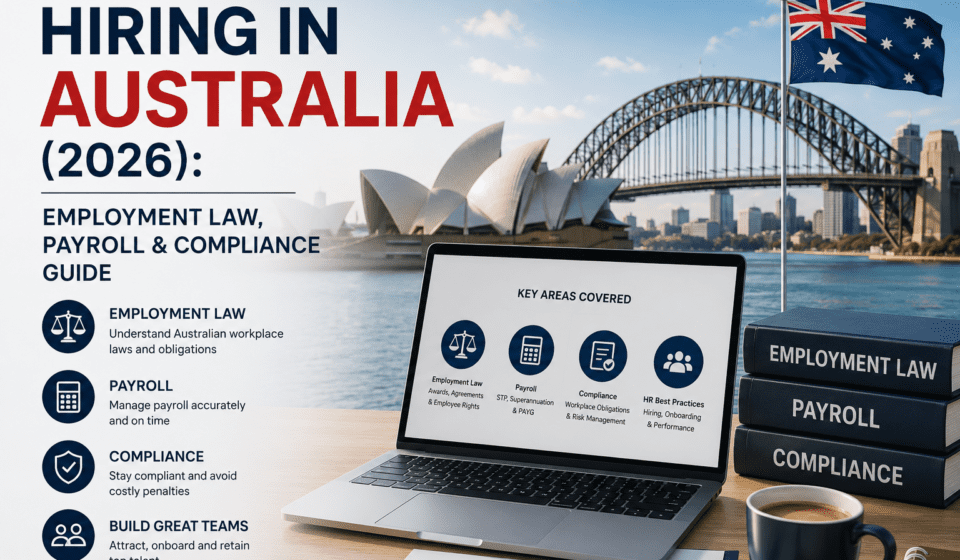
Hiring in Australia (2026): Employment Law, Payroll & Compliance Guide

Australia is one of the most attractive destinations for international businesses looking to hire in the Asia-Pacific region. With a stable economy, a highly educated English-speaking workforce, and a strong legal system, hiring in Australia in 2026 offers significant opportunities for global companies expanding into the region.
But hiring in Australia comes with a unique set of legal obligations, payroll requirements, and compliance challenges that businesses must understand before they bring on their first Australian employee. Getting it wrong can result in serious financial penalties, back payments, and legal disputes.
This guide covers everything you need to know about hiring in Australia in 2026, including employment law, payroll and tax obligations, employee entitlements, compliance risks, and how Deel makes the entire process fast, simple, and fully compliant.
Why Hire in Australia in 2026?
Australia has a workforce of approximately 14 million people, with particular strength in technology, finance, mining, healthcare, and professional services. The country’s economy is resilient, its business environment is transparent, and its legal system is reliable and well-established.
For international businesses, Australia offers a gateway into the Asia-Pacific region, strong consumer demand, and access to talent that is both highly skilled and English-speaking. The country’s time zone also makes it practical for businesses serving Asian markets.
However, Australian employment law is detailed and strictly enforced. The Fair Work Act 2009 is the cornerstone of employment regulation in Australia, and the Fair Work Ombudsman actively investigates and penalizes businesses that fail to meet their obligations. Understanding the rules before you hire is essential.
Australian Employment Law: The Basics
The primary piece of legislation governing employment in Australia is the Fair Work Act 2009. This Act establishes the National Employment Standards, sets the framework for modern awards and enterprise agreements, regulates unfair dismissal claims, and provides for the resolution of workplace disputes.
The Fair Work Act applies to the vast majority of employers and employees in Australia. It is administered by the Fair Work Commission, which handles disputes and sets minimum employment conditions, and the Fair Work Ombudsman, which investigates and enforces compliance.
In addition to the Fair Work Act, employers in Australia must comply with state and territory-specific legislation in some areas, including workers compensation, long service leave, and occupational health and safety.
Types of Employment in Australia
When hiring in Australia, businesses can engage workers in several different ways. Understanding the distinction between these categories is critical for compliance.
Full-Time Employment
Full-time employees in Australia work an average of 38 ordinary hours per week and are entitled to the full range of National Employment Standards entitlements, including paid annual leave, personal leave, and notice of termination.
Part-Time Employment
Part-time employees work fewer than 38 hours per week on a regular and systematic basis. They receive the same entitlements as full-time employees on a pro-rata basis.
Casual Employment
Casual employees work irregular hours with no guaranteed ongoing work. They receive a casual loading — currently 25 percent on top of the base pay rate — in lieu of entitlements such as paid annual leave and sick leave. Under recent changes to Australian employment law, long-term casuals may have the right to convert to permanent employment after twelve months of regular work.
Independent Contractors
Engaging workers as independent contractors is possible in Australia, but the line between employees and contractors is strictly policed. Misclassifying an employee as a contractor — known as sham contracting — is illegal under the Fair Work Act and carries serious penalties.
The National Employment Standards
The National Employment Standards (NES) set out ten minimum entitlements that apply to all employees covered by the Fair Work Act, regardless of their award or agreement. These standards cannot be reduced or removed by any employment contract or agreement.
The ten National Employment Standards cover maximum weekly hours of work, requests for flexible working arrangements, offers and requests for parental leave and related entitlements, annual leave, personal and carer’s leave, community service leave, long service leave, public holidays, notice of termination and redundancy pay, and the requirement to provide a Fair Work Information Statement to all new employees.
Minimum Wage in Australia in 2026
Australia has a national minimum wage that is reviewed annually by the Fair Work Commission. The national minimum wage applies to employees who are not covered by a modern award or enterprise agreement.
Most employees in Australia are covered by a modern award, which sets industry or occupation-specific minimum pay rates and conditions. These award rates are typically higher than the national minimum wage. Employers must identify which award or awards apply to their employees and pay at least the applicable award rate.
Paying below the applicable minimum wage or award rate is a serious breach of Australian employment law. The Fair Work Ombudsman actively investigates underpayment complaints, and penalties for deliberate underpayment can be substantial. Businesses should verify the current applicable minimum wage and award rates at the time of hiring.
Payroll in Australia: Tax and Superannuation
Running payroll in Australia involves several distinct obligations that employers must manage accurately and on time.
Income Tax and PAYG Withholding
Australia operates a pay-as-you-go (PAYG) withholding system. Employers are required to withhold income tax from employee salaries and wages and remit it to the Australian Taxation Office (ATO) on a regular basis — either monthly or quarterly depending on the size of the withholding obligation.
The amount of tax to be withheld depends on the employee’s total earnings, their tax residency status, and whether they have provided a Tax File Number (TFN) declaration. Employees who do not provide a TFN must have the highest marginal tax rate withheld from their pay.
Superannuation
One of the most distinctive aspects of Australian payroll is the superannuation guarantee. Employers are required by law to make superannuation contributions on behalf of all eligible employees to a compliant superannuation fund. The superannuation guarantee rate has been increasing gradually over recent years and stands at 11.5 percent of an employee’s ordinary time earnings as of 2024, with further increases scheduled. Businesses hiring in Australia in 2026 should verify the current applicable superannuation guarantee rate.
Superannuation contributions must be paid at least quarterly into the employee’s nominated superannuation fund. Failure to pay superannuation on time and in full results in the superannuation guarantee charge, which includes the unpaid amount, an interest component, and an administration fee — making non-compliance significantly more expensive than compliance.
Payroll Tax
Payroll tax is a state and territory-based tax on the wages paid by employers. It applies once an employer’s total Australian wages exceed a certain threshold, which varies by state and territory. Businesses with employees in multiple states may have payroll tax obligations in more than one jurisdiction. The rates and thresholds differ across states, and managing payroll tax correctly requires careful tracking of wages by location.
Single Touch Payroll
Australia operates a Single Touch Payroll (STP) reporting system, under which employers report employee salary and wage information, tax withheld, and superannuation contributions to the ATO each time payroll is run. This real-time reporting requirement means that payroll errors are quickly visible to the tax authorities, making accuracy essential.
Employee Entitlements and Leave in Australia
Australian employees are entitled to a comprehensive set of leave entitlements under the National Employment Standards and applicable modern awards.
Annual Leave
Full-time and part-time employees are entitled to four weeks of paid annual leave per year. Employees engaged on shift work may be entitled to five weeks. Annual leave accrues progressively throughout the year and can be taken by agreement between the employer and employee, or directed by the employer in certain circumstances.
Personal and Carer’s Leave
Full-time employees are entitled to ten days of paid personal and carer’s leave per year, which can be used for personal illness or injury or to care for an immediate family or household member who is sick or injured. Employees are also entitled to two days of unpaid carer’s leave per occasion when paid leave is exhausted.
Parental Leave
Eligible employees are entitled to up to twelve months of unpaid parental leave, with the right to request a further twelve months. Employees must have completed at least twelve months of continuous service to be eligible. The Australian government also provides a paid parental leave scheme that provides government-funded payments to eligible primary carers for a period after the birth or adoption of a child.
Public Holidays
Australia has national public holidays as well as state and territory-specific public holidays. The national public holidays include New Year’s Day, Australia Day, Good Friday, Easter Monday, Anzac Day, the King’s Birthday (date varies by state), Christmas Day, and Boxing Day. Employees are entitled to be absent from work on public holidays without loss of pay.
Long Service Leave
Long service leave is an entitlement to an extended period of paid leave after a long period of continuous service with the same employer. The entitlement varies by state and territory but typically provides for between six and thirteen weeks of paid leave after ten years of continuous service. Businesses operating across multiple states must be aware of the different long service leave obligations in each jurisdiction.
Compliance Risks When Hiring in Australia
Australia’s employment regulatory environment is active and well-resourced. The Fair Work Ombudsman has broad investigative powers and regularly takes enforcement action against businesses that fail to meet their obligations.
Underpayment of Wages
Underpayment of wages — whether through failure to pay award rates, incorrect classification of employees, or errors in calculating leave entitlements — is one of the most common compliance failures in Australia. The Fair Work Ombudsman receives thousands of underpayment complaints every year. Deliberate underpayment can result in penalties of up to $93,900 per contravention for individuals and up to $469,500 per contravention for corporations under current legislation.
Sham Contracting
Engaging an employee as an independent contractor in order to avoid employment entitlements — known as sham contracting — is explicitly prohibited under the Fair Work Act. Businesses found to have engaged in sham contracting face substantial financial penalties and are required to back-pay all employment entitlements that were avoided.
Superannuation Non-Compliance
Failure to pay superannuation contributions on time and in full is one of the most serious payroll compliance risks in Australia. The ATO actively monitors superannuation compliance and pursues businesses that fail to meet their obligations. Directors of companies that fail to pay superannuation can be held personally liable for the unpaid amounts.
Modern Award Compliance
Identifying the correct modern award for each employee and ensuring that all pay rates and conditions meet award minimums is a complex but essential compliance requirement. Australia has over 100 modern awards covering different industries and occupations, and determining which award applies requires careful analysis of the employee’s role and industry.
How Deel Simplifies Hiring in Australia
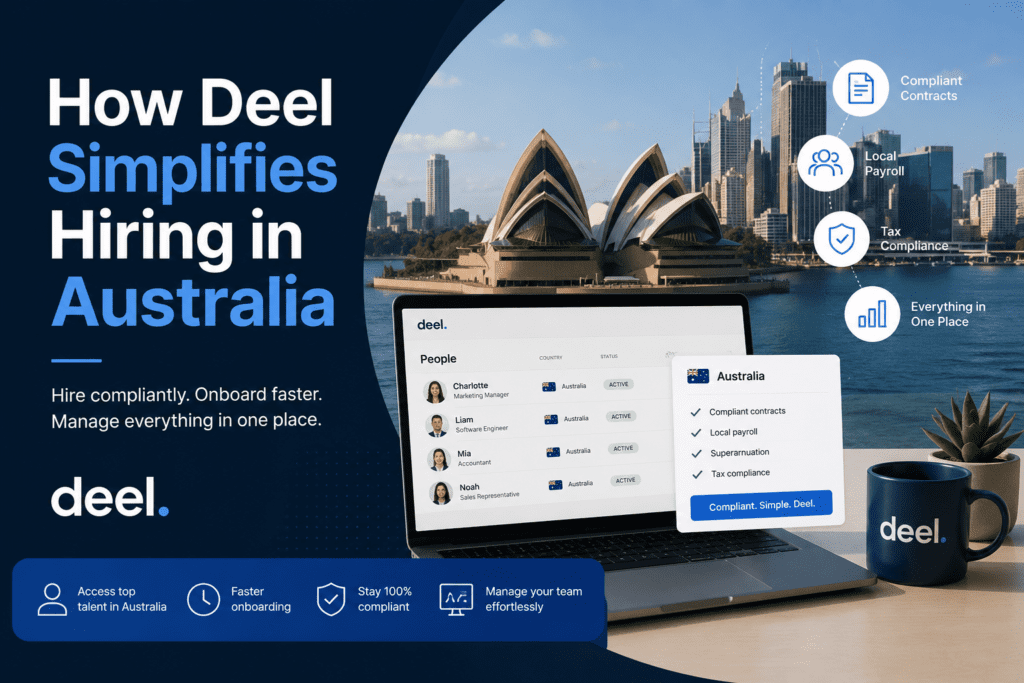
Deel is a global workforce management platform that allows businesses to hire employees and contractors in Australia — and over 150 other countries — without setting up a local entity. Deel has in-country expertise in Australian employment law and payroll, making it one of the most reliable ways to hire compliantly in Australia.
Deel generates employment contracts that are fully compliant with Australian employment law, incorporating all required terms under the Fair Work Act and applicable modern awards. This eliminates the risk of using a non-compliant contract template that fails to meet Australia’s detailed legal requirements.
Deel manages Australian payroll including PAYG withholding, superannuation contributions at the correct rate, and Single Touch Payroll reporting to the ATO. Everything is calculated accurately and submitted on time, removing the risk of payroll errors, late superannuation payments, and the significant penalties that accompany them.
Deel ensures that all National Employment Standards entitlements — annual leave, personal leave, parental leave, public holidays, and notice periods — are correctly calculated and provided. Long service leave obligations are also tracked and managed by Deel’s in-country team.
For businesses without an Australian legal entity, Deel’s Employer of Record service allows companies to hire Australian employees quickly and legally, with Deel acting as the legal employer on paper while employees work exclusively for the client’s business. This eliminates the need to establish an Australian company, register as an employer with the ATO, and manage ongoing compliance obligations independently.
Ready to hire in Australia without the complexity?
This guide is provided for informational purposes only and does not constitute legal or tax advice. Employment law, tax regulations, and superannuation rates in Australia are subject to change. For advice specific to your situation, we recommend consulting a qualified employment lawyer or using a compliant platform such as Deel.